
Income Tax Filing India | Expert ITR Services | Bharat Comply
File your income tax return in India with expert help from Bharat Comply. Accurate, timely ITR filing for individuals and businesses. File today.
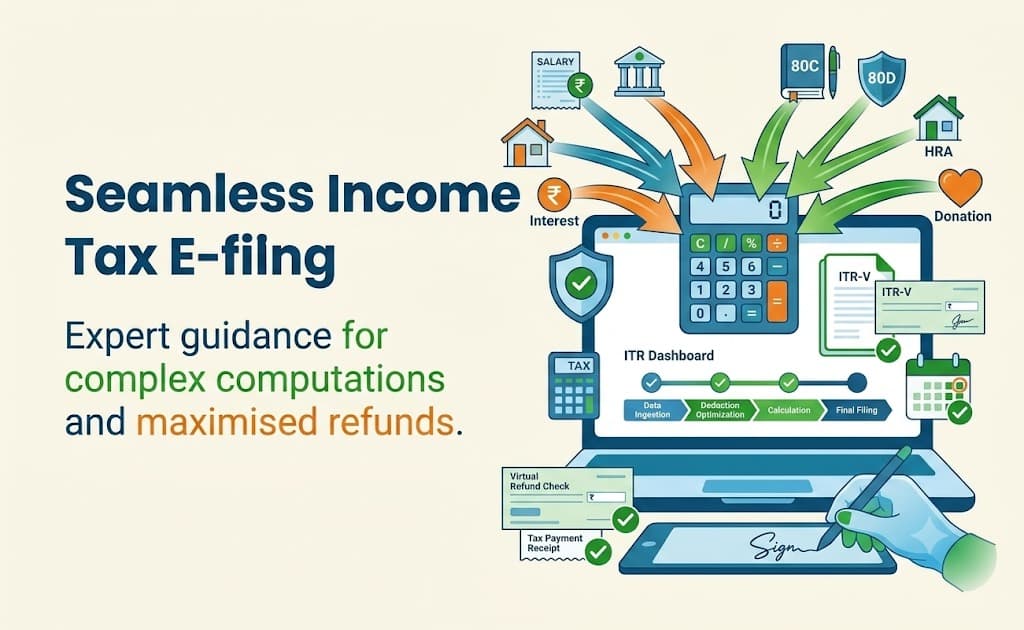
Overview
Income tax filing in India is the process of reporting income, taxes paid, deductions, and financial information to the Income Tax Department every financial year through an Income Tax Return (ITR).
Individuals, freelancers, professionals, businesses, LLPs, and companies are required to file income tax returns based on income thresholds and applicable legal requirements.
Accurate and timely income tax filing helps taxpayers remain compliant, claim refunds, avoid penalties, and reduce the risk of notices caused by mismatches or incorrect reporting.
Who Needs Income Tax Filing in India?
Individuals and Salaried Employees
Individuals earning above the prescribed exemption limit are generally required to file income tax returns. Filing may also become necessary in certain high-value transaction cases even when income is below the threshold.
Freelancers and Professionals
Freelancers, consultants, and independent professionals must report business or professional income through the applicable ITR forms.
Businesses and Companies
Proprietorships, partnership firms, LLPs, and companies are required to file income tax returns regardless of profitability status.
What Are the Different Types of Income Tax Returns?
ITR-1
ITR-1 is commonly used by salaried individuals with relatively simple income sources.
ITR-3
ITR-3 applies to professionals and individuals earning business or professional income.
ITR-4
ITR-4 is used for taxpayers opting for presumptive taxation schemes under applicable income tax provisions.
ITR-6
ITR-6 is filed by companies registered under the Companies Act.
Selecting the correct ITR form is essential for accurate processing and compliance.
How Does the Income Tax Filing Process Work?
Step 1: Collect Financial Documents
Salary slips, Form 16, bank statements, invoices, investment proofs, and other financial records are gathered before filing.
Step 2: Calculate Total Income
Income from salary, business, profession, capital gains, interest, rental income, and other applicable sources is consolidated.
Step 3: Apply Eligible Deductions
Deductions under sections such as 80C, 80D, and other applicable provisions are applied while computing taxable income.
Step 4: Compute Tax Liability
The applicable tax payable or refund amount is calculated after adjusting TDS, advance tax, and self-assessment tax.
Step 5: File and Verify the Return
The return is filed online through the income tax portal and verified using Aadhaar OTP, digital signature, or other permitted verification methods.
What Documents Are Required for Income Tax Filing?
- PAN card and Aadhaar card
- Salary slips and Form 16
- Bank statements
- Investment and deduction proofs
- Business income and expense records
- TDS certificates and tax payment details
The required documents vary depending on whether the taxpayer is salaried, self-employed, or operating a business.
What Are the Benefits of Filing Income Tax Returns?
Claim Tax Refunds
Taxpayers can claim refunds if excess TDS or advance tax has been paid during the financial year.
Income Proof for Loans and Visas
Filed income tax returns are commonly required by banks, financial institutions, and embassies during loan and visa applications.
Maintain Financial Compliance
Regular tax filing demonstrates financial transparency and legal compliance for both individuals and businesses.
Avoid Penalties and Notices
Accurate and timely filing helps reduce the risk of late fees, penalties, and notices from the Income Tax Department.
Common Mistakes in Income Tax Filing
Incorrect Income Reporting
Failure to disclose all income sources may lead to discrepancies and tax notices.
Wrong Deduction Claims
Deductions claimed without supporting documentation can create assessment issues.
Using the Wrong ITR Form
Filing the incorrect return form may lead to rejection or defective return notices.
Delayed Filing
Missing the filing deadline may result in penalties, interest, and restricted carry-forward benefits for certain losses.
How Does Bharat Comply Help?
- Income calculation and tax liability computation
- Selection of the correct ITR form
- Identification of eligible deductions and exemptions
- Online filing and return verification support
- Notice response and compliance assistance
- Business and professional tax filing support
Bharat Comply provides structured and transparent income tax filing support for individuals, freelancers, startups, SMEs, and businesses across India.
Key Benefits
Our Process
Collect Financial and Tax Documents
Income records, bank statements, Form 16, investment proofs, and business financial documents are gathered for return preparation.
Calculate Total Taxable Income
Income from all applicable sources is consolidated and reviewed to determine total taxable income and available deductions.
Select Correct ITR Form
The appropriate income tax return form is selected based on the taxpayer category, business activity, and nature of income.
Prepare and File Income Tax Return
The return is prepared accurately and filed online through the Income Tax Department portal with complete compliance checks.
Verify Return and Provide Filing Acknowledgement
The filed return is verified electronically and filing acknowledgements are shared for future records and compliance purposes.