
Private Limited Company Registration in Bharat
The most trusted business structure for startups and growing businesses. Get incorporated with full MCA compliance, DSC processing, and end-to-end documentation support.
Choose Your Package
Transparent pricing for Pvt Ltd Registration. No hidden charges.
Basic
What you'll get
- Company name help
- SPICe+ form in 2–3 working days
- Company PAN + TAN
- MOA + AOA
- PF and ESIC registration
- Incorporation certificate in 10–12 days
- DSC preparation in 3–4 days
- DIN for directors
- Expert assisted process
- INC 20A / Business commencement certificate
- Support for unlimited shareholders
- Authorized Capital with No Limit
- Bank Account Opening Assistance
- MSME Registration
- Startup India Registration
- Digital signature certificate
- Company DSC
- Trademark Filing
Standard
What you'll get
- Company name help
- SPICe+ form in 2–3 working days
- Company PAN + TAN
- MOA + AOA
- PF and ESIC registration
- Incorporation certificate in 10–12 days
- DSC preparation in 3–4 days
- DIN for directors
- Expert assisted process
- INC 20A / Business commencement certificate
- Support for unlimited shareholders
- Authorized Capital with No Limit
- Bank Account Opening Assistance
- MSME Registration
- Startup India Registration
- Digital signature certificate
- Company DSC
- Trademark Filing
Premium
What you'll get
- Company name help
- SPICe+ form in 2–3 working days
- Company PAN + TAN
- MOA + AOA
- PF and ESIC registration
- Incorporation certificate in 10–12 days
- DSC preparation in 3–4 days
- DIN for directors
- Expert assisted process
- INC 20A / Business commencement certificate
- Support for unlimited shareholders
- Authorized Capital with No Limit
- Bank Account Opening Assistance
- MSME Registration
- Startup India Registration
- Digital signature certificate
- Trademark Filing
Not sure which package fits your business?
Overview
- Private limited company registration in Bharat is the legal process of incorporating a business under the Companies Act, 2013, administered by the Ministry of Corporate Affairs (MCA). Once registered, your company becomes a separate legal entity — it can own assets, enter into contracts, and operate independently from its owners. Registration is done through the MCA's online portal using the SPICe+ (Simplified Proforma for Incorporating Company Electronically Plus) form.
- A private limited company is the most commonly chosen structure by startups, growing businesses, and investors in India. As of March 2024, over 25 lakh companies are registered with the MCA, and private limited companies account for the majority of active registrations.
- If you are starting a business, raising funding, or moving from a sole proprietorship, this structure offers legal protection, credibility, and long-term scalability that other structures do not.
How Is a Private Limited Company Different from an LLP or Proprietorship?
Not every business structure works for every situation. Here is how a private limited company compares to the two most common alternatives.
- Private Limited Company vs. LLP (Limited Liability Partnership): A private limited company is owned by shareholders and managed by directors. It can raise equity investment and issue shares. An LLP, by contrast, is managed by partners and cannot issue shares to investors. If you plan to raise venture capital or bring in angel investors, a private limited company is almost always the required structure.
- Private Limited Company vs. Sole Proprietorship: A sole proprietorship has no legal separation between the owner and the business, meaning personal assets can be at risk if the business faces a legal dispute or debt. A private limited company limits each shareholder's liability to the value of their shares, protecting personal savings, property, and other assets.
- Private Limited Company vs. One Person Company (OPC): An OPC allows a single founder to have a separate legal entity, but it cannot have more than one shareholder and cannot raise external investment. A private limited company allows up to 200 shareholders and is built for businesses that plan to grow or collaborate.
Why Should You Register a Private Limited Company in Bharat?
- Legal Protection Through Limited Liability: In a private limited company, the personal assets of directors and shareholders are protected. If the company faces a financial loss or legal claim, the liability of each shareholder is limited to the unpaid amount on their shares — one of the most important protections any business owner can have.
- Credibility With Clients, Banks, and Investors: Registered companies inspire confidence. Banks require incorporation documents to open business accounts or approve loans. E-commerce platforms like Amazon and Flipkart require sellers to be registered entities. Virtually every institutional investor or venture capital firm will only fund a registered private limited company.
- Access to Government Startup Benefits: Startups registered as private limited companies and recognised by DPIIT under the Startup India scheme can access income tax exemptions for three consecutive years, faster patent processing, and relaxed compliance norms. To qualify, the company must be less than ten years old and have annual turnover below ₹100 crore.
- Perpetual Existence and Transferability: A private limited company continues to exist even if a director resigns, a shareholder exits, or an owner passes away. Shares can be transferred, making it easier to bring in new partners or plan an exit strategy.
What Documents Are Required for Company Registration in Bharat?
Having complete and accurate documents is one of the most important factors in a smooth registration process. Missing or incorrect documents are the most common cause of delays.
For All Proposed Directors and Shareholders
- PAN card (mandatory for Indian nationals)
- Aadhaar card or passport (identity proof)
- Passport-size photographs
- Latest bank statement or utility bill as address proof (not older than 2 months)
For the Registered Office
- Electricity bill or water bill of the premises (not older than 2 months)
- Rent agreement (if premises are rented)
- No Objection Certificate (NOC) from the property owner
- If the address is owned by a director, a utility bill in their name is sufficient
Company Documents
- Memorandum of Association (MoA): defines the company's objectives
- Articles of Association (AoA): define internal rules and governance
- These are drafted as part of the SPICe+ filing process
- Foreign directors must submit notarised and apostilled copies of their passports and address proof.
Key Benefits
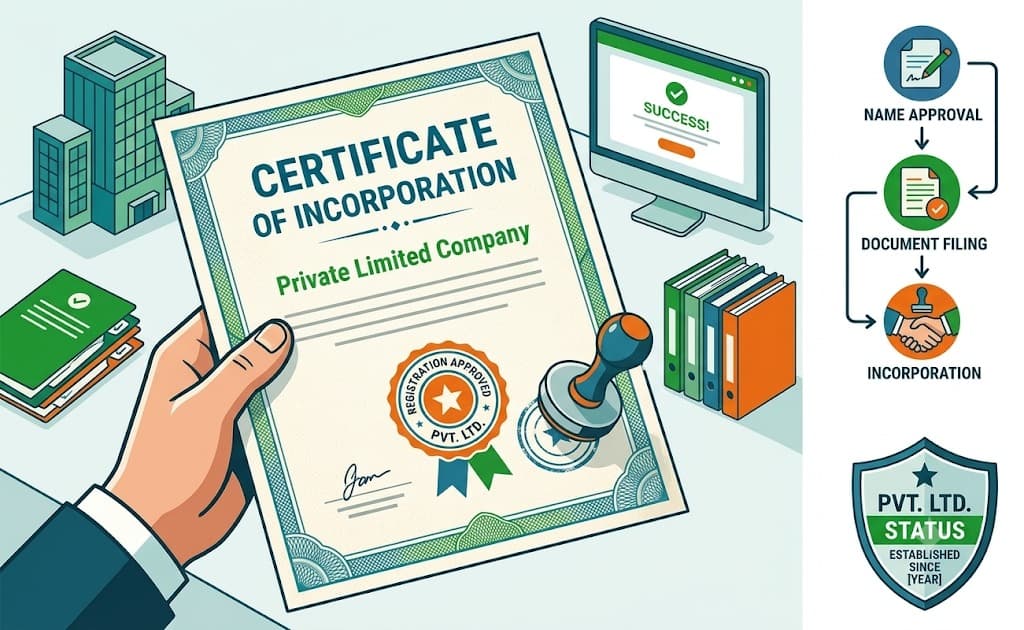
Our Process
Obtain Digital Signature Certificates (DSC)
All proposed directors must obtain a Class 3 Digital Signature Certificate from a government-authorised certifying authority. The DSC is used to sign all electronic filings submitted to the MCA and must be completed before any forms are filed.
Apply for Director Identification Numbers (DIN)
A DIN is a unique identification number allotted to every individual who wants to serve as a director. DIN can be applied for within the SPICe+ form itself for up to three directors, making it a combined step in the current process.
Name Approval via RUN or SPICe+
The proposed company name must comply with MCA naming guidelines, the Companies (Incorporation) Rules 2014, and trademark considerations. Name approval can be applied for through the RUN (Reserve Unique Name) service or within the SPICe+ form.
File the SPICe+ Form with MoA, AoA, and AGILE-PRO-S
SPICe+ is a consolidated application that handles incorporation, DIN allotment, PAN, TAN, EPFO, ESIC, and GST registration in a single filing. Along with SPICe+, you must file AGILE-PRO-S and submit the e-MoA and e-AoA.
Receive the Certificate of Incorporation (CoI)
Once the Registrar of Companies (ROC) reviews and approves the filing, a Certificate of Incorporation is issued electronically. The CoI contains the Corporate Identification Number (CIN), and the company's PAN and TAN are also issued at this stage.
Sample Certificate
This is what the Certificate of Incorporation issued by the Ministry of Corporate Affairs looks like. Personal details have been hidden.