
File ITR Online India | Bharat Comply Tax Services
File your ITR online in India with ease at Bharat Comply. Expert-assisted income tax return filing for all taxpayer categories. Get started today.
Overview
Filing ITR online in India is the process of reporting income, taxes paid, deductions, and financial information to the Income Tax Department through the official income tax e-filing portal.
Every year, millions of taxpayers file returns incorrectly due to wrong ITR form selection, TDS mismatches, incomplete verification, or inaccurate reporting. Proper filing requires understanding the applicable rules, deadlines, and documentation before submission.
Bharat Comply provides expert-assisted online ITR filing services for salaried individuals, freelancers, businesses, startups, LLPs, companies, and NRIs across India.
Who Must File ITR in India?
Individuals Based on Income Threshold
Individuals whose gross total income exceeds the applicable exemption limit are required to file income tax returns under the Income Tax Act.
Businesses and Companies
All companies, LLPs, and partnership firms must file income tax returns annually regardless of whether they generated profit or incurred losses.
Freelancers and Professionals
Freelancers, consultants, and professionals earning business or professional income are required to file returns using the appropriate ITR forms.
Special Filing Situations
Individuals with capital gains, foreign assets, multiple house properties, or certain specified financial transactions may also be required to file returns even if income falls below exemption limits.
Understanding Financial Year and Assessment Year
The Financial Year (FY) is the year in which income is earned, while the Assessment Year (AY) is the year in which that income is reported and taxed.
Correctly selecting the applicable assessment year during filing is essential because errors at this stage may require revised returns and additional compliance steps.
Which ITR Form Should You Use?
ITR-1
Used by salaried individuals with relatively simple income structures and limited income sources.
ITR-2
Applicable to individuals with capital gains, foreign income or assets, or multiple house properties.
ITR-3
Used by individuals and HUFs earning income from business or profession, including most freelancers and consultants.
ITR-4
Applicable to taxpayers opting for presumptive taxation under Sections 44AD, 44ADA, or 44AE.
ITR-5, ITR-6, and ITR-7
These forms apply to LLPs, partnership firms, companies, trusts, and other specified entities depending on their structure and activities.
Filing under the wrong ITR form may result in defective return notices and processing delays.
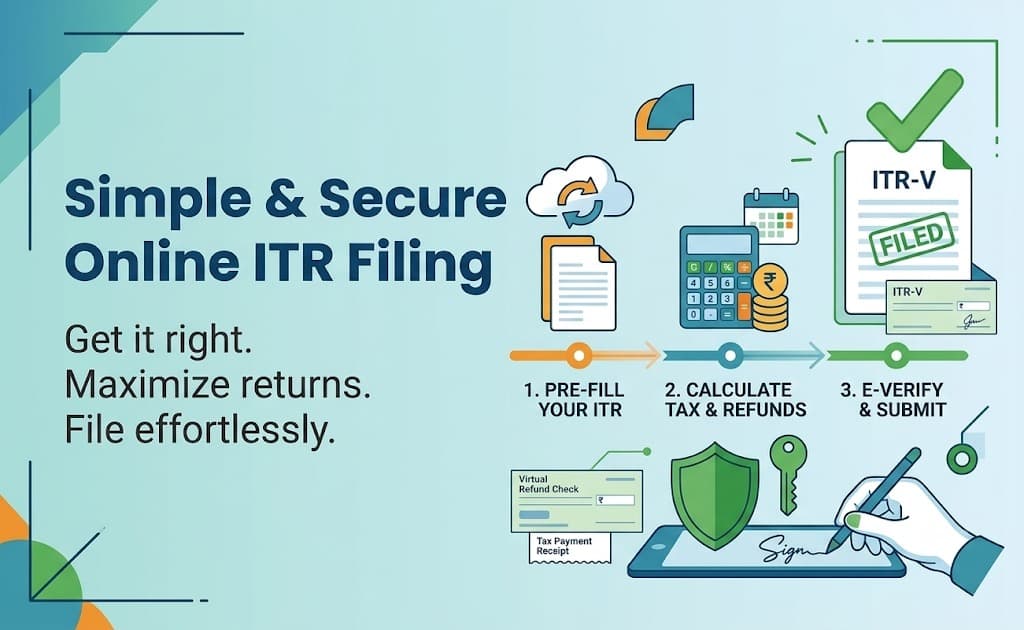
How to File ITR Online in India
Step 1: Gather Financial Documents
Important documents include PAN, Aadhaar, Form 16, Form 26AS, AIS, bank statements, investment proofs, and business records where applicable.
Step 2: Log in to the Income Tax Portal
Taxpayers access the income tax e-filing portal using PAN credentials and select the relevant assessment year and return type.
Step 3: Enter Income and Deduction Details
Income under all heads is reported along with eligible deductions and tax credits. Figures should be cross-verified against AIS and Form 26AS records.
Step 4: Compute Tax Liability
Tax payable or refund due is calculated after adjusting TDS, advance tax, and self-assessment tax payments.
Step 5: Submit and Verify the Return
After submission, the return must be verified through Aadhaar OTP, net banking, digital signature, or other approved methods within the prescribed timeline.
Important ITR Filing Deadlines
- July 31 for most individuals and non-audit cases
- September 30 for tax audit report filing
- October 31 for businesses and audit cases
- December 31 for belated return filing
Missing filing deadlines may result in penalties, interest, and restrictions on carrying forward certain losses.
Common Errors That Trigger Income Tax Notices
Wrong ITR Form Selection
Using an incorrect return form is one of the most common causes of defective return notices.
TDS and AIS Mismatches
Income and TDS figures that do not match Form 26AS or AIS records may trigger scrutiny or automated notices.
Incomplete E-Verification
An unverified return is treated as unfiled even if uploaded successfully on the portal.
Incorrect Reporting of Income
Missing interest income, capital gains, or other taxable receipts can create discrepancies during processing.
What Does Bharat Comply's ITR Filing Service Include?
- Identification of the correct ITR form
- Review and reconciliation of AIS and Form 26AS
- Tax computation and deduction optimisation
- Online return filing and e-verification support
- Advance tax guidance and compliance support
- Post-filing notice and rectification assistance
Bharat Comply helps taxpayers file ITRs online accurately, on time, and with complete compliance support across all major taxpayer categories in India.
Key Benefits
Our Process
Collect Tax and Financial Documents
PAN, Aadhaar, Form 16, AIS, Form 26AS, bank statements, investment proofs, and business records are gathered before filing.
Determine Correct ITR Form
The correct income tax return form is selected based on income sources, entity type, and applicable tax provisions.
Compute Income and Tax Liability
Income under all heads is calculated along with deductions, exemptions, TDS credits, and any additional tax payable.
File Return Online
The return is prepared and filed electronically through the official income tax portal with complete compliance checks.
Complete E-Verification and Compliance Support
The return is verified using approved methods and filing acknowledgements along with post-filing support are provided.